From a 500-deck crowdfunding run to a 200,000-deck retail programme, the work starts in the same place: a physical sample you can approve. Below are the project types we handle and the five ways we sample them. This page covers custom card projects in detail.
Publishers, game studios, spiritual brands, agencies, and distributors bring us a wide range of custom card projects. We produce playing cards, trading cards, card games, tarot decks, oracle decks, and flash cards, together with their boxes and booklets. Most enquiries fall into the six project types below. Each project follows a specification-led workflow: artwork review, proof approval, production, packing, and shipping.
Base sets, rarity tiers, foil and holographic treatments, collation plans, and reprints produced against the approved specification and production reference.
Card counts from 40 to 400, plus tokens, rulebooks, insert trays, and boxes designed around the complete game set.
78-card decks and custom card counts, gilded edges, multilingual guidebooks, and rigid magnetic boxes.
Casino decks, promotional decks, corporate gift sets, and premium retail decks with custom card backs and tuck boxes.
Ring-bound sets, boxed decks, rounded corners, and material or coating options selected for your market and testing requirements.
Rigid boxes, tuck boxes, tin and wooden cases, rulebooks, and guidebooks coordinated with the deck.
Each option verifies a different part of the project. Use the material sample kit to compare stocks and finishes, or a digital proof to check artwork and dielines. A custom printed sample shows the finished deck, and an on-press approval sheet confirms production color and registration. Select the option that matches the current project stage; the four options are not necessarily sequential.
We offer a free standard sample kit for you to evaluate before placing a bulk order. The kit contains representative unbranded samples of cardstock grades, finishes, and packaging structures. Provide your delivery address and cover the shipping cost; our sales team will arrange dispatch.
Representative cardstock grades, laminations, coatings, foil applications, spot UV examples, and box structures. Best for comparing physical materials before finalizing a specification.
Dispatched in around 3 working days. The customer covers the shipping cost. See sample pack options
A PDF proof of your artwork, checked for trim size, bleed, safe area, color mode, resolution, and dielines. It confirms layout and artwork placement but does not predict exact printed color or physical finish.
Fastest option, usually within 1–2 working days. Included in our free dieline and artwork check.
Your artwork produced as a finished deck using the agreed specification. This is the most representative option for reviewing materials, dimensions, surface finish, cutting, handling, and packaging before bulk production.
Ready in 5–7 days after the print-ready files and specification are confirmed. Quoted per project.
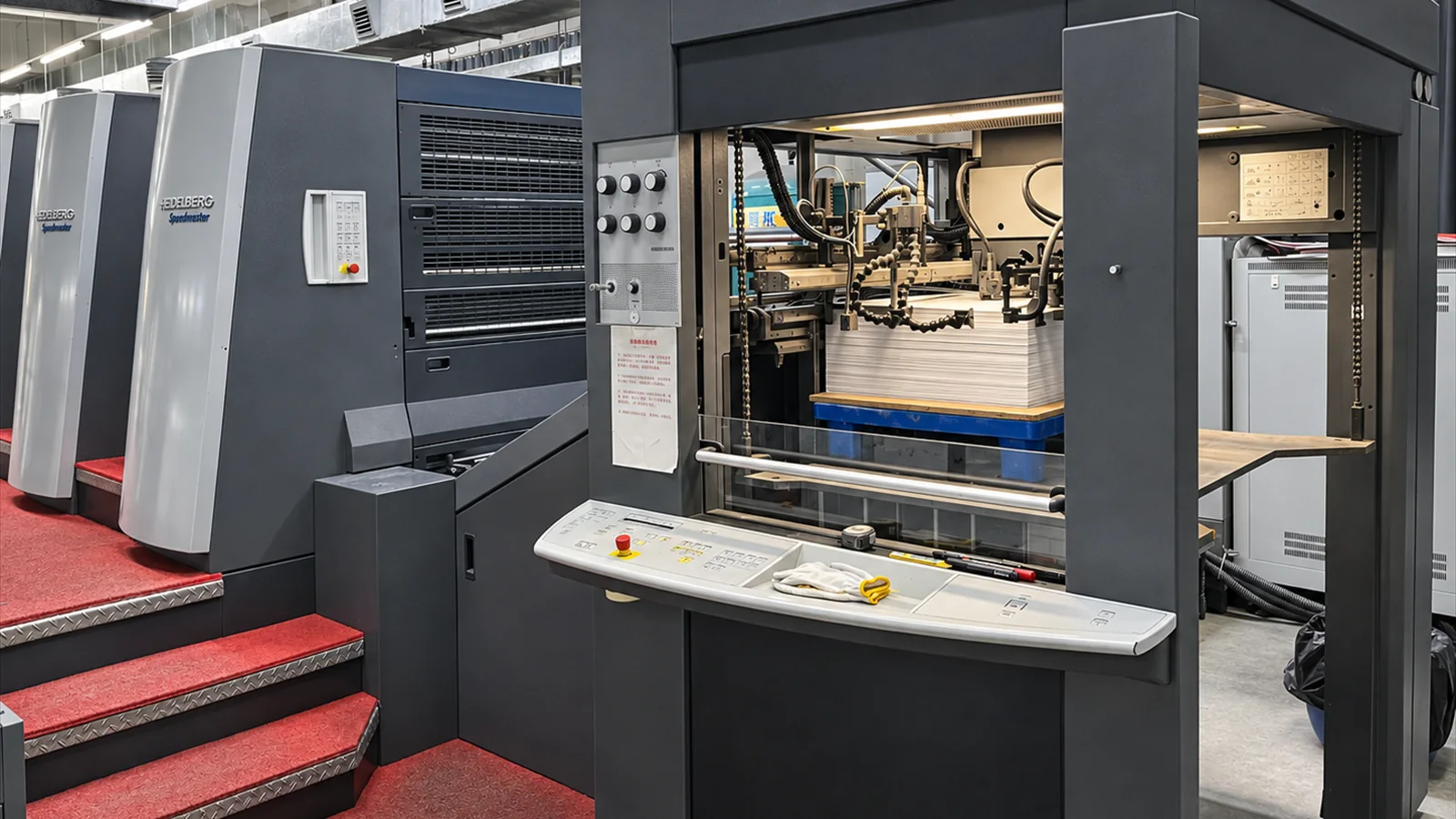
A press sheet reviewed during make-ready at the start of the Heidelberg XL105 production run. It is used to approve printed color, registration, and appearance on the specified stock before the run proceeds, subject to the agreed manufacturing tolerances.
The final on-press color and registration check before production continues. Quoted per project.
Choose the option according to what must be verified: physical materials and finishes, artwork setup, the finished product, or on-press color and registration.
The standard sample kit is complimentary. Custom sampling is quoted per project. The customer covers the shipping cost.
The appropriate option depends on what must be approved next. Compare materials before finalizing the specification, review artwork before printing, or use a physical or on-press reference when the production specification is ready.
Start with the standard sample kit. Handle and compare the cardstock, finish, and packaging samples, then finalize the specification before ordering a custom printed sample.
Choose a custom printed sample to review the intended cardstock, finish, dimensions, handling, and packaging before production. The approved sample becomes a production reference, subject to the agreed tolerances.
A project may use more than one option. For example, a sample kit can support material selection, followed by a digital proof, custom printed sample, or on-press approval when the corresponding specification is ready.
Record sample approval in writing against six project-specific checks. The approved details should match the quotation, artwork files, and material specification, within the production tolerances.
Compare with the approved Pantone target, CMYK reference, brand guide, or physical color standard. Do not judge printed color from a backlit screen alone.
Confirm the cardstock grade, grammage, caliper, stiffness, opacity, and handling characteristics. Core color is only one part of the paper construction. See cardstock materials
Confirm the specified coating or lamination, embossing or texture, gloss level, surface friction, and shuffle or dealing performance. See finishing options
Check finished card size, trim position, corner radius, front-to-back registration, and the permitted cutting tolerance.
Confirm the internal dimensions, deck clearance, tray depth, closure, and fit of any booklet or accessory. See custom card boxes
Check shrink wrapping, individual pack-out, carton quantity, carton marks, labels, and barcode requirements.
Short answers on samples, timing, and minimums. For anything else, see the full SGallo FAQs.
Sampling is one stage of approval. These pages explain the related production stages, materials, finishing options, and quality controls.
Six steps from quote request to shipping
Black core, blue core, and art paper
Foil, spot UV, and gilding
Three-stage QC before packing
ISO, FSC, and EN 71
Answers on MOQ, samples, and timelines
Send your project stage, specification status, and target date. We will recommend the appropriate sampling or proofing option and reply with a detailed quotation within 24 hours.
ISO 9001, ISO 14001, and ISO 45001 certified. FSC-certified paper is available, with EN 71 or REACH testing support for products that require it. Five utility patents cover production equipment and processes. See certifications
No. 2 Fuling Road, Tangmei Village, Xintang Town, Zengcheng District, Guangzhou, China