
Producing custom game cards means locking four things before plates: the component list, the print files, the collation rule and the pack. Get those right and production is 15–20 days; get collation wrong and a 5,000-set order can be repacked by hand at the end of the line.
Step 1: write the component list
Start with a table rather than a deck. List every physical item: 60 game cards, 12 token cards, 1 rules booklet, 1 tuck box, 1 shrink wrap. For each item record size in millimetres, stock, print sides, finish, and quantity per set. This table becomes the quotation, the proof checklist and the packing specification.
Most cost overruns come from items that were never on the list: a folded insert, a sticker seal, a card divider. Add them now, because adding them after the box is die-cut means a new die.
Step 2: prepare print files that survive preflight
- One PDF per printed surface, CMYK, with 3mm bleed and crop marks.
- Text and hairlines at least 0.25pt, or they fill in at 175 lpi.
- Rich black where you want density; pure black for body text.
- White ink layer named as a spot colour if the card has foil or clear stock.
- Fonts embedded, and every card the same trim size.
We check files before plate making at no charge. The errors that reach us most often are RGB blacks, text inside the bleed, and back-to-front misregistration on cards with a border.
Step 3: proof on the real stock
A digital proof on office paper tells you nothing about a 330gsm black core card with linen lamination. Ask for a physical prototype on the final stock. At SGallo a prototype takes 5–7 working days, and it is the only reliable way to judge snap, edge colour and how a dark back reads through a light face.
Sign the prototype and keep it. When the bulk run arrives, that signed deck is the reference for a claim.
Step 4: print, laminate, cut
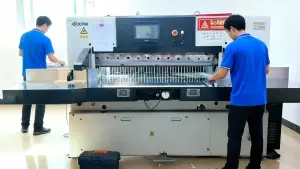
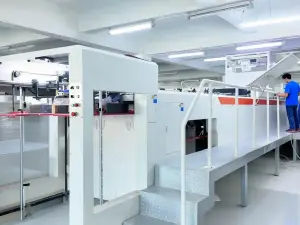
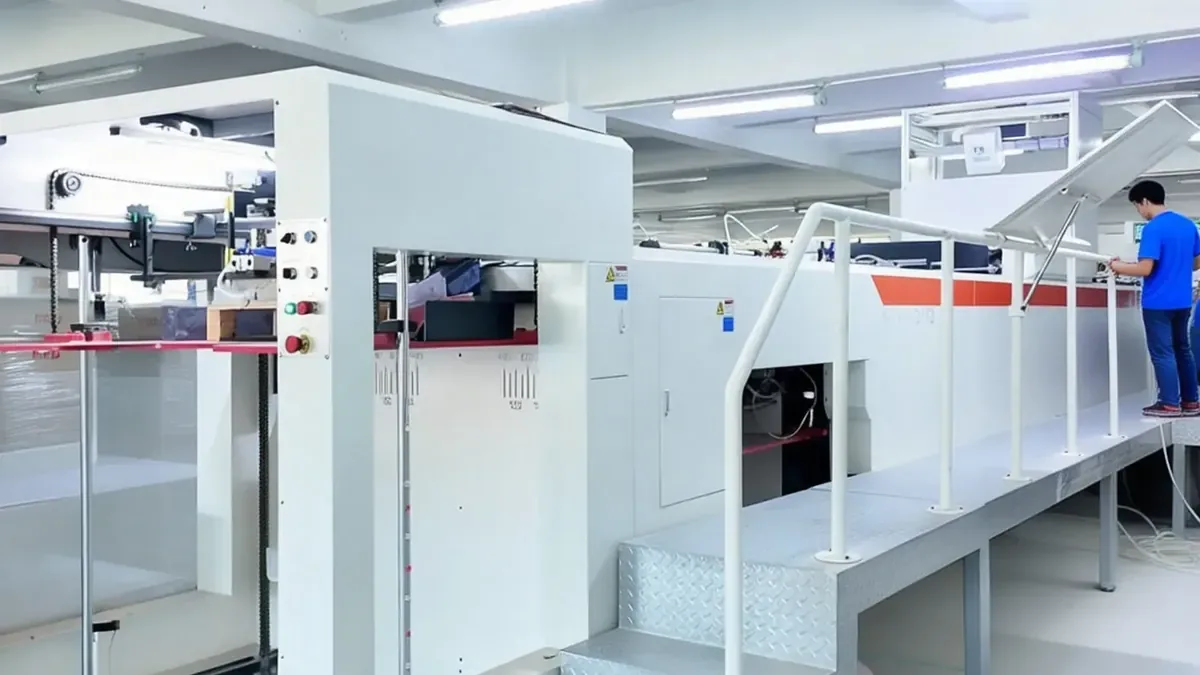
Sheets are printed on the offset press, then laminated with the chosen film: matte, gloss, linen or soft-touch. Lamination is not decoration; it is what lets a card slide, resist moisture and survive a riffle. After curing, the sheets are die-cut to the finished size, and the die tolerance is what decides whether 60 cards stack square.
Corner radius matters more than buyers expect. R3.5 is the usual game-card corner; R5 is softer and common on family games. Choose one and keep it across expansions, because mixed radii are obvious in a shuffled deck.
Step 5: collate, then pack
Collation is the order cards enter the set. A 60-card deck with fixed order is simple. A collectible set with rarity ratios is not: if you want one rare in every six packs, the line has to be programmed, and the ratio has to be tested on a sample run.
Packing decisions follow the retail channel. A tuck box with shrink wrap suits hobby distribution; a rigid two-piece box with an insert tray suits a $40 collector edition; a printed tin suits a gift SKU. Each adds tooling, and each changes the carton count, which changes freight.
| Stage | Typical time | Output you approve |
|---|---|---|
| Component list and quote | 2–3 days | Specification table |
| Preflight | 1–2 days | Corrected PDF set |
| Prototype | 5–7 days | Signed physical deck |
| Print and finish | 8–12 days | Sheets, laminated, die-cut |
| Collation and packing | 3–5 days | Shrink-wrapped sets, cartons |
| QC and handover | 1–2 days | Inspection report, photos |
Where game card projects usually go wrong
- A box designed before the deck thickness is confirmed, so the lid is 2mm too tight.
- Rules booklets printed at a different supplier, arriving after the cards and holding the whole set.
- Rarity ratios agreed verbally, then implemented by hand on the packing table.
- No carton weight check, so the freight forwarder re-palletises at the port.
Sourcing custom game cards: what to send for a quote
A quote for custom game cards is only as good as the specification behind it. Send five things and you will get a comparable number instead of a range: the component list, the card count per set, the finished size, the desired stock and finish, and the packing format. Add the destination port and the launch date, and the reply becomes a schedule rather than a guess.
Artwork can follow. Preflight is free, and a supplier who insists on final files before giving a price is hiding the fact that the price depends on decisions you have not made yet.
The five-line specification
- Contents: 60 game cards, 12 tokens, 1 rules booklet, 1 tuck box.
- Size: 63 × 88 mm, R3.5 corner, 3mm bleed.
- Stock and finish: 330gsm black core, matte BOPP both sides.
- Quantity: 1,000 sets, with a reprint option at the same specification.
- Packing and delivery: shrink-wrapped set in tuck box, 40 sets per carton, FOB Shenzhen.
That block is enough to price the job. It is also the document the QC team will inspect against, which is why writing it down saves an argument later. Our custom game cards page shows the same structure in more detail, and the quality inspection page explains what is checked at each stage.
If the deck uses certified paper, say so at quotation stage. FSC chain-of-custody has to be booked with the stock, and switching to certified paper after printing starts is usually impossible. The FSC register lists which printers hold a valid certificate.
Packing formats and what each one costs you
A tuck box is the cheapest pack and the most common for a 60-card game sold under $20. It needs a die, prints on one sheet, and packs flat for freight. A rigid two-piece box with an insert tray protects tokens and a rulebook, and it is the format used for collector editions; the tooling costs more and the carton count rises because the box does not pack flat.
A printed tin sits between the two on cost and above both on durability. It survives a drop that dents a paper box, and it is reusable, which buyers notice. The trade-off is weight: a tin adds 40–60g per set, and on a 5,000-set order that is a pallet.
Whatever the format, confirm the deck thickness before the box die is cut. A 60-card deck at 330gsm with 18 micron film measures about 20mm; the same deck at 350gsm with 25 micron film measures 22mm, and a box drawn for 20mm will not close.
What to check before the cartons are sealed
Inspect before packing, not after delivery. Open three cartons from different pallets and check four things: the card count in each set, the collation order against your list, the box closure and the shrink wrap seal. Then weigh one carton and compare it with the packing list. A 300g difference usually means a booklet or a token set is missing from some units, and it is far cheaper to find that at the factory than at a warehouse overseas.
FAQ
What is the MOQ for custom game cards?
MOQ is 500 sets per design for standard specifications. Below 500, setup costs dominate and the per-set price rises sharply. Sample and prototype orders can be as small as one deck.
Can you handle booster pack collation?
Yes, with a programmed ratio confirmed on a sample run before mass production. Provide the pack configuration, the rarity table and the desired distribution, and we will test the sequence on 50–100 packs for your approval.
Do you print rulebooks and inserts too?
Yes. Saddle-stitched and perfect-bound booklets, folded inserts and divider cards are produced in the same plant, which keeps the schedule and the colour consistent with the cards.