
A reliable custom trading card manufacturer owns its presses, quotes a fixed card stock and grammage, runs in-house foil and varnish, and can show you a delivered TCG project with the same specifications. Choose on equipment and documents, not on a price list.
Most buyers start with a price table and end up with a colour problem. The shortlist should be built from what the supplier can prove, because trading cards are printed on tight registration, cut to 0.2 mm, and judged under artificial light in a shop. A trading company can forward your files to a factory, but it cannot answer why the second run came out warmer than the first.
Check 1: does the supplier own the press?
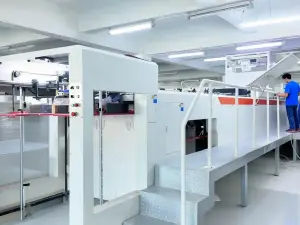
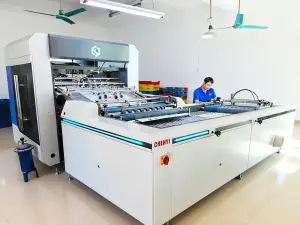
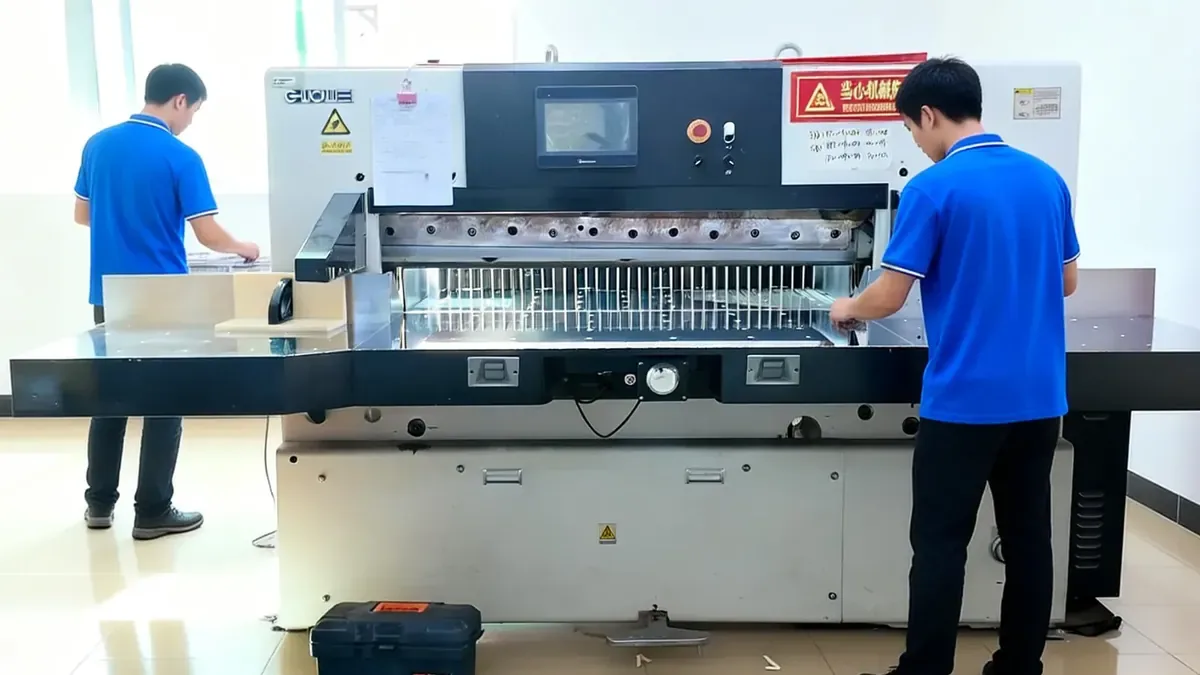
Ink behaviour depends on the machine, the operator and the plates. If your sample is printed on one press and the bulk run on another, the same CMYK file can shift two or three points. Our decks, foils and varnishes all run through a Heidelberg XL105 on one site in Zengcheng, Guangzhou, which is why a reprint matches the approved proof.
Ask for a photo of the machine with your job on it, or a short video call during the run. A supplier who cannot show the press is brokering the job.
Check 2: is the card stock specified by name?
"300gsm art paper" describes weight, not construction. Trading cards usually need a black core or blue core so the deck stays opaque and snaps cleanly when shuffled. Japanese black core at 330gsm behaves differently from a domestic black core at the same weight: stiffer, smoother edge, less show-through under strong light.
Ask for the core type, the mill, the finished thickness in millimetres and a physical sample. If the answer is only a weight, the quote is not comparable with another supplier's.
Check 3: which finishing steps happen in-house?
Holographic film, foil stamping, spot UV and gilded edges are where most schedules break. Each is a second pass with its own drying time, and each is commonly subcontracted. When foil is outsourced, a 500-deck run can wait a week for a slot at another workshop.
Ask which steps are on site. For collectible cards, also ask how foil is registered to the print: a 0.2 mm tolerance is realistic on a good line, and a supplier who cannot state a number is guessing.
Check 4: is preflight and proofing included?
A free artwork check catches the expensive errors: RGB blacks, text inside the bleed, hairlines that will fill in at 175 lpi, and white ink that is missing under a holographic area. Preflight should happen before plates, not after the first proof.
Samples take 5–7 working days. Treat that window as part of the evaluation: a supplier who rushes a sample usually rushes the run. Approve the sample under the light your buyer will use, then sign it as the reference.
Check 5: what does MOQ actually change?
MOQ 500 decks is common because plate, die and setup costs are fixed. Below 500, unit cost rises sharply rather than the order being refused. Above 500, the curve flattens and packing becomes the constraint. Ask for the price at 500, 1,000 and 5,000 before you design the box, because the box is often what breaks the budget.
Check 6: can they produce the compliance file?
Retail buyers ask for paper and ink documentation. FSC chain-of-custody covers the stock, EN71-3 covers migration for toys and children's products, and ISO 9001 covers the process. These are documents, not claims: ask for the certificate number and the expiry date, and check the scope covers card printing.
If your deck ships to the EU, also confirm low-migration inks and a declaration for the food-contact case, which applies to some game and collectible packaging.
Check 7: can they show a comparable delivered job?
A portfolio of stock images proves nothing. Ask for three projects with the same stock, size and finishing as yours, plus the market they shipped to and the order volume. Then ask one operational question that only the producer can answer, such as how they collate a 120-card set with two insert ratios.
| Trading company | Card factory | |
|---|---|---|
| Press | Outsourced, changes per order | Own Heidelberg XL105 |
| Sample vs bulk | Often different machines | Same line, same ink |
| Finishing | Scheduled at partners | In-house foil, UV, edge print |
| Answer on stock | Grammage only | Core, mill, thickness, sample |
| Problem solving | Forwards your email | Reads the file, fixes the plate |
Red flags worth walking away from
- A quote that lists a price without stock, size, finishing and packing.
- Foil or gilded edges promised "in about a week" with no line named.
- No physical sample before a deposit, or a sample that is a different size from the quote.
- Certificates offered as logos on a website rather than as PDFs with numbers.
What a custom trading card manufacturer should ask you
A serious custom trading card manufacturer asks questions before quoting, because the answers can move the price by a third. If the first reply is a number with no questions attached, the number is a guess. The questions should cover card count, finished size, stock, print sides, finishing, box, quantity and destination.
Questions about the deck itself
How many cards per deck, and will the set grow with an expansion? What is the finished size in millimetres, and does the back need to be perfectly registered to the front? Is the artwork final, or will it be revised after the first proof? These answers decide the plate count, the die and the paper layout, which together are most of the fixed cost.
Questions about the run and the calendar
How many units for the first print, and is there a reprint window before launch? When does the artwork need to be final? Which finishing steps are on the critical path? A supplier who maps your launch date backwards to a plate date is planning; one who promises "about three weeks" is not.
Questions about delivery and documents
Which port or airport, and under which Incoterm? Does the buyer need FSC or EN71 paperwork attached to the invoice? Will the cartons be labelled for a marketplace? Getting these right at quotation stage avoids a re-labelling job at the warehouse.
The answers also tell you who you are dealing with. A factory answers in specifications and dates. A broker answers in adjectives. Our custom trading cards page lists the specifications we ask for first, and the FAQ covers the questions buyers send most often.
Compliance documents worth asking for by name
Three documents cover most retail requirements. FSC chain-of-custody proves the paper came from a certified forest and is checked at the mill and the printer. EN71-3 covers migration of heavy elements for products handled by children. ISO 9001 covers the process, not the product, but it tells a buyer that nonconformities are recorded and corrected.
- FSC certificate with a code and an expiry date that covers the printer, not only the mill.
- EN71-3 test report on the actual inks and varnish used for your run.
- ISO 9001 certificate with a scope that mentions printing or paper conversion.
- A low-migration ink declaration if the packaging touches food or cosmetics.
Ask for the PDFs, not the logos. The FSC register lets you verify a certificate code in a minute, and a supplier who cannot provide one is not certified for that product line.
How to run the comparison fairly
Send the same specification sheet to three suppliers and ask each to quote against it line by line, including stock, finishing, packing and freight. Then compare the sample, not the price. A quote that is 10% lower usually differs on stock, lamination thickness or carton quality, and those differences show up six weeks later at the warehouse.
Finally, ask what happens when something goes wrong. Replacement policy, reprint lead time and the name of the person who answers are part of the product. A supplier who will not put that in writing is telling you something useful.
FAQ
How long does a custom trading card order take?
Sampling takes 5–7 working days after artwork is approved. Mass production runs 15–20 days for 500 to 5,000 decks, then 3–7 days for packing and handover. Sea freight adds 25–40 days, air freight 5–10 days.
Can I order fewer than 500 decks?
Yes, below 500 decks is possible on most specifications. Unit cost rises because plate, die and setup are fixed, so a 200-deck run is a sample-scale order rather than a small production run. We quote both and let you compare per-deck cost.
Do you print licensed or IP-based trading cards?
Only with written authorisation from the rights holder. Trading cards featuring well-known IPs require proof of licence before production, and we will ask for it at the quotation stage rather than after the plates are made.